 When the editor-in-chief of Wired Magazine comes to Milan, Italy, you simply take the first train e go asking him a few questions. Thank God Chris Anderson, who’s also author of the book “The Long Tail” (2006), is both a journalist and a blogger and does enjoy a conversation in pure “web2.0 style”. During the interview we (obviously) talked about the Long Tail and the new freedom of choice it provides to the customers. Then I asked him if the so-called “social networking revolution” is affecting the Long Tail Economy, and if this economic model really works out of the media and entertainment industry. There was enough time to discuss the way his blog helped him writing and promoting the book, as well as to exchange ideas about the internet in broad terms. We even talked about the way he and his wife, who doesn’t love technology at all, manage (and protect) their children’s approach to the Internet.
In the end there was room for an amazing revelation: Italy is the country of niche markets and has always been ahead in the Long Tail economy. Today technology is just allowing the rest of the world making up for lost time.
Enjoy.
Alessio Jacona: three years have passed since the day you published your article about the Long Tail on Wired Magazine. Is it still true that “The biggest money is in the smallest sales.”?
Chris Anderson “It depends on what you mean with the “smallest sales”. In general the Long Tail, that is all the products beyond the mass market, beyond the hits, it’s also the fastest growing part of every industry: in some case it is a third of the business, in same case it is half of the business; it depends on where you define “head” and “tail” but, you know, just look at the music industry and you can certain see what happened since the market shifted away from the blockbusters and towards an infinite number of niches.”
AJ: who takes advantage of the Long Tail economic model? Creators of contents, small firms, big companies, the customers?
CA: “Fundamentally the big winner is the customer. An infinite choice means that you can find out and have what you want, that you can explore new things and lower the transaction costs of discovering. The advantages for producer are sometimes monetary, but there are also other forms of payment: reputation, attention, traffic. Traditionally, we thought that only one thing could motivate production: money. Today it turns out that lots of things could motivate production and, thanks to many simple tools of production and distribution, we’re finding out just how many people are willing to create things for reasons that have nothing to do with cash.”
AJ: Brian Clark of CopyBlogger wrote that the only ones to take advantage of the Long Tail are firms like Netflix and Amazon, which aggregate lots of contents.
CA: “Or Google, for what that matter. Any aggregator. This notion that the Long Tail works only if you can make money, is a very narrow view. You know, I’m trying to preach the virtues of the non-monetary economy and apparently I’m having not very much success, cause people continues to make this mistake. Anyway, it’s true that the main monetary beneficiaries of the Long Tail are the aggregators, but you and I, for example, are beneficiaries as consumers too. People who are uploading videos to Youtube, the bloggers, etc., they are beneficiary as well, just not monetary. I think this kind of narrow, money-centric perspective on the market is a mistake, and I’m hoping to teach people not to do that.”
AJ: you settled three “rules” for the companies involved in the Long Tail economy. The third was: “Help me find it”. Once, there was just Amazon.com with its “Recommendations”. Now there’s the so-called social networking revolution, the paradise of word-of-mouth. Do you think this new environment is affecting the Long Tail Economic model?
CA: “It obviously is the greatest filter of the world we’ve ever seen. Most people, when they think about help finding something on line, they would think about Google. The search engine measures the word-of-mouth using incoming links and therefore organizes the Internet. I think that, long before social networking, the very creation of the hyperlink was a form of taking the word-of-mouth and transforming it in something that the machines could understand, that they use to filter the world on line and make it useful to people. So what we see now it’s entirely not new.
What is new is the rise of more “explicit” social networking and we see element of this all the way back to Friendster as well as now in Facebook and Myspace. It’s a little bit like “playlists”: they are a way to discover music using this “magic carpet” of somebody else’s taste. So playlists are an early form of social network, which is to say that two individuals exchange information by one leading the other.
We now see that model applying to everything else: if I can watch your buying and media consumption behaviour, where you go or what you do, – which is the kind of “living in public” that we see right now in social networking – that’s a form of playlist and it’s going to influence my taste. Today this has become in many way’s more powerful than advertising.”
AJ: So social networking is based on an ancient behaviour – the word-of-mouth – hugely powered by the internet?
CA: “That is exactly what the web is: the world’s greatest word-of-mouth amplifier.”
AJ: you have five young children. How do you manage their approach to the internet? Do you feel the need to protect them from it?
CA: “That’s a great question and, like all parents, I don’t have a good answer for you. My children are all under ten and my wife pretty much hates technology, so she really doesn’t like the children using computers. I know it’s pretty ironic but that’s it. Of course I love technology, but I love my wife more, so we’ve found a compromise: we’re very limiting in how the children use the internet. For example, we let them use Google only on “safe search”, we don’t let them go in MySpace or World of Warcraft and we let them use only the most kid-friendly social networks, like “club penguin”.
That said, I find interesting what they do in school, teaching the children how to use Wikipedia to start a research, but also explaining them they have to check another independent source, like in professional journalism, to verify their information. This way Wikipedia is not the end but the beginning of research.”
AJ: you decided to write a book and then, quite at the same time, started a blog about that very book. Did it help writing it? And selling it?
CA: “I always say that the blog made my book better but later. It took me longer to write it because blogs are very compelling and they tend to distract you.
That said, I think the blog made three things: first, the article came out on 2004 while the book was published in 2006. My first concern was that my could disappear in those two years, would have been stolen by someone else or simply lose momentum. So the reason why I started blogging was just to fill the dead air between article and book, to keep the conversation going.
Then I discovered that the blog was helping me to write the book: my readers did provide many examples, hints and corrections, turning this book into a distributed research project. And when it came time to release the book, I had this audience of about 50 thousand people a day who had been really working with me on the book. They become a natural word-of-mouth marketing engine.
AJ: shall we call it your corporate blog?
CA: “In a sense, but because the book has been done in public, in conversation with the readers, it wasn’t like I was just promoting it. I think they really did feel it was a group effort, and so what they were promoting wasn’t just me, but something they participated at.
AJ: in the beginning you wrote about the benefits of The Long Tail in the media and entertainment industries. With the book you went further, explaining that these principles are equally applicable to other market. Would you make us some examples?
CA: The Long Tail perfectly applies to the media and entertainment industries on line. After the book came out, I was surprised to see how many examples came out that had nothing to do with the internet: short after my book was published Anheuser-Busch, a big beer manufacturer in America, created a new division called “Long Tail Libations”. I asked them what the Long Tail beer was: the answer is a larger number of beer products aimed at niche consumers. One of their product is a gluten-free beer for people with gluten–allergies, so I asked them: “Why did it take until 2007 to release the world’s first gluten free beer? It is made from sorghum, not wheat or barley, and Egyptian already knew it”.
They answered me that the “Long Tail effect” we see in internet is just a mirror of something broader that is just happening in our culture as a whole. As we became richer as customer and better educated in doing our choices, we also became more discriminating, we develop a more refined taste.
That’s way once there was just coffee, while now Starbucks has 36 thousand different varieties of it. Now we’re in Milan, which is the birthplace of the niche market of high fashion (which sells small quantities at very high prices). So in a sense, this notion that discriminating consumers don’t want a one-size-fits-all product is completely conventional here.
AJ: you look at the Internet from a privileged point of view. Is it just a new medium or something more?
CA: I don’t know what the words “media”, “journalism” or “news” mean anymore. I’m apparently in the media business, editor in chief of Wired Magazine, and here we are, two bloggers talking of something which is going to appear on the Internet but it’s neither journalism nor news. It is a conversation. So the Internet is simply “human”, is our society made explicit. I’m having semantic problems with the word “media” and I think we need a new word. Media comes from medium, means something is between you and me, so in this case even “air” could be the media. This word used to mean something long time ago and then turned in something different in recent time. Now I think we’ve lost its meaning.
AJ: how do you see Europe and, above all, Italy? Here we always have the feeling we’re four or five years late.
CA: I think of it the other way. I think that the rest of world is catching up to where Italy was hundred of years ago. Think about it: a nation defined by small and medium size businesses, a nation with two major industries, being wine and fashion, which have always been niche businesses. In a sense, technology is just allowing the rest of the world to embrace the values this country has always celebrated. So you’re not behind, you’re ahead.
AJ: sounds quite optimistic, but thank you. Now the last question: how would you explain Long Tail for dummies?
CA: Long Tail for newcomers? I think it is the discovery of life beyond blockbusters, life beyond the mass market. Long Tail is what happens when mass market fragments and turns into millions of niche markets. In this new markets of infinite choice, we’re actually discovering ourselves, discovering who we are, what we like and what we really want rather than just sailing through what’s been offered in traditional market places of limited choice. Now we can choose anything and what we discover is the diversity implied in our culture along.
AJ: Can we say that the Long Tail is more freedom for us as customer?
CA: Absolutely. It means more freedom for us to do what we want and discover who we are.
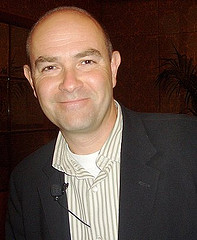
Photo: Blognation Italy

 The Web Observer